- Get link
- X
- Other Apps
Astronomers are Racing to Study Our Solar System's Newest 'Interstellar Visitor.' Here's Why.
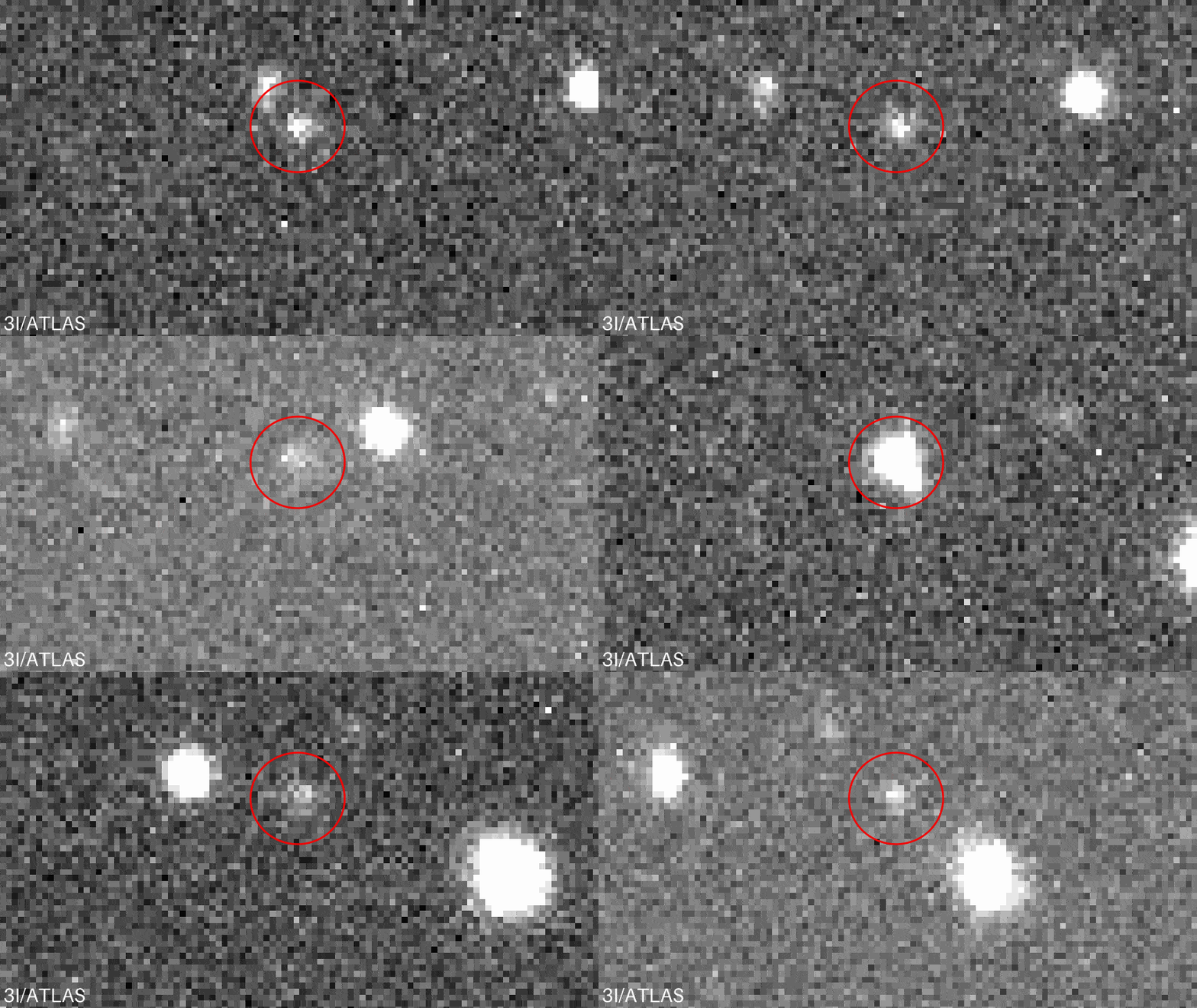
The astronomical community is buzzing with excitement over the recent discovery of a new "interstellar object," the third of its kind ever observed. This cosmic wanderer, named 3I/ATLAS, is currently hurtling towards us on a one-way journey through our solar system.
A frantic race is now underway to study this alien interloper before it disappears forever. As Darryl Seligman, an astronomer at Michigan State University and lead author of a new paper on the object, stated, "We only have one shot at this object, and then it's gone forever. So we want as much information from all of our observatories as we can possibly get."
But why all the fuss? Experts believe that studying 3I/ATLAS could unlock secrets about distant star systems and how exoplanets form. We might even be able to trace its origins back to its home system.
The Initial Discovery
3I/ATLAS (previously dubbed A11pl3Z) was first spotted on July 1st, thanks to data collected by the Asteroid Terrestrial-impact Last Alert System (ATLAS). Its trajectory and astonishing speed immediately raised eyebrows. Traveling at over 130,000 mph (210,000 km/h), it was clear that this was no ordinary space rock. Within 24 hours, NASA confirmed its interstellar status.
Just a day later, a team of over 40 astronomers, led by Seligman, had already published a paper describing this extrasolar entity on the preprint database arXiv. The data so far suggests that 3I/ATLAS is a large comet, enveloped in a cloud of ice, dust, and gas that stretches up to 15 miles (24 kilometers) across.
Prior to this, only two other interstellar objects (ISOs) had been detected:
- 1I/'Oumuamua: A space rock discovered in 2017.
- 2I/Borisov: A comet spotted in 2019.
This makes the newly discovered comet an exceptionally valuable target for astronomers.
The Clock is Ticking
The window of opportunity to study 3I/ATLAS is limited. Currently about 4.5 times farther from the sun than Earth, the comet will reach its closest point to the sun (perihelion) on October 30th. After that, it will begin its long journey out of our solar system, becoming increasingly difficult to observe. Furthermore, it will be out of sight from late September to early December as it passes on the opposite side of the sun from Earth.
How Scientists Plan to Observe it
Over the coming weeks and months, researchers plan to utilize "any and all telescopes" available to observe 3I/ATLAS, according to Sean Raymond, a planetary scientist at the University of Bordeaux in France.
Observatories in the Southern Hemisphere will be particularly crucial, as they will have a better vantage point of the increasingly bright comet, notes Aster Taylor, a graduate student at the University of Michigan and co-author of the arXiv study.
Specific instruments and plans include:
- Vera C. Rubin Observatory: Experts are excited about the prospect of using this observatory, the world's most powerful optical telescope, to image 3I/ATLAS.
- James Webb Space Telescope (JWST) & Hubble Space Telescope: These telescopes could help determine the interloper's chemical composition by studying it across multiple wavelengths.
- Mars Rovers: There is even discussion of using NASA's Mars rovers to capture images of the comet as it passes by the Red Planet shortly before perihelion.
Although some have proposed a mission to collect samples from 3I/ATLAS, the likelihood of such a mission is low.
Unlocking Secrets of Alien Star Systems
Studying 3I/ATLAS offers a unique chance to gain insights into alien star systems and potential exoplanets.
"Interstellar objects are probably the leftovers of the formation of exoplanets," Raymond explained. "Studying them can open a window into understanding other planetary systems' formation and evolution."
In this way, ISOs like 3I/ATLAS also "connect the solar system with its galactic environment," according to Amir Siraj, a doctoral candidate at Princeton University.
Although the precise origin of 3I/ATLAS remains a mystery, researchers hope to pinpoint its birthplace. Determining its age and studying the volatile substances that burn off as it reaches perihelion could provide valuable clues. However, even with this data, "we probably won't ever be able to pin it down to a single star system," Taylor conceded.
The fleeting visit of 3I/ATLAS presents a remarkable opportunity for astronomers to expand our understanding of the cosmos. While its origins may remain elusive, the data gathered in the coming months will undoubtedly contribute significantly to our knowledge of exoplanetary systems and the interstellar environment. Let's hope they find what they're looking for!
Tags: Interstellar comet, 3I/ATLAS, Solar system, Alien object, Astronomy, Space, Exoplanets, Darryl Seligman, Michigan State, Interstellar visitor
Source: https://www.livescience.com/space/comets/astronomers-are-racing-to-study-our-solar-systems-newest-interstellar-visitor-heres-why
Comments
Post a Comment