- Get link
- X
- Other Apps
Article Heading: Engine Fuel Supply Cut Just Before Air India Jet Crash, Preliminary Report Says
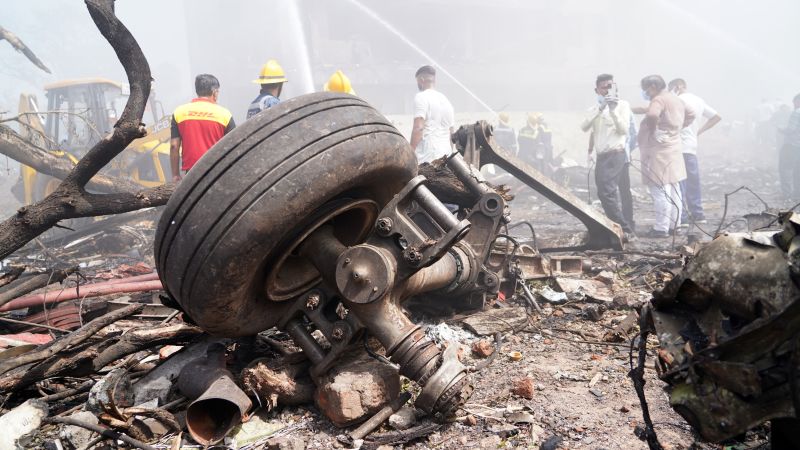
A preliminary report has revealed a chilling detail in last month's Air India crash that claimed the lives of 260 people: a cut in the fuel supply to the engines just moments before the disaster. The London-bound Boeing 787 Dreamliner, operating flight AI171, had barely lifted off from Ahmedabad airport when tragedy struck.
The Aircraft Accident Investigation Bureau of India's report, obtained by CNN, points to the fuel control switches in the cockpit as the critical factor. These switches, which control the flow of fuel to the engines, were flipped to the "CUTOFF" position, effectively starving the engines. The report remains inconclusive as to whether this action was intentional or accidental.
Key Findings from the Preliminary Report:
- Data Recovery: Investigators successfully retrieved data from the aircraft's "black box" recorders, including 49 hours of flight data and two hours of cockpit audio leading up to the crash.
- Critical Moment: The aircraft reached an airspeed of 180 knots when both engines' fuel cutoff switches were abruptly switched from "RUN" to "CUTOFF" within a single second.
- Pilot Confusion: The cockpit voice recording captured a pilot asking why the fuel was cut off, with the other pilot denying any involvement.
- Recovery Attempt: The switches were quickly reversed, and the engines began the process of powering back up. Sadly, it was too late to avert the impending disaster.
The placement and design of the fuel cutoff switches on the Boeing 787 are particularly noteworthy. Situated between the pilots' seats, behind the throttle levers, they are protected by a metal bar and feature a locking mechanism intended to prevent accidental activation. CNN safety analyst David Soucie emphasized the rarity of such an event, stating that improvements over the years have made accidental fuel cutoff extremely unlikely.
Additional Information from the Report:
- Airport footage revealed the deployment of the Ram Air Turbine (RAT), an emergency power source, during the plane's initial climb.
- The aircraft began losing altitude before crossing the airport perimeter.
- The report confirms that when the fuel control switches are moved back to the "RUN" position in flight, the engine's full authority digital engine control (FADEC) system automatically initiates a relight and thrust recovery sequence.
- Seconds after the engines attempted to relight, one of the pilots issued a "MAYDAY MAYDAY MAYDAY" call.
- Investigators confirmed standard settings for takeoff equipment, satisfactory fuel quality, and no significant bird activity in the flight path.
- The takeoff weight was within limits, no dangerous goods were on board, and the flaps were correctly set at 5 degrees for takeoff.
The flight crew consisted of a seasoned 56-year-old captain with over 15,000 flying hours and a 32-year-old first officer with over 3,400 flying hours. The left and right engines were installed on March 26th and May 1st, respectively.
The aftermath of the report's release has been filled with grief and calls for justice. Naresh Maheswari, who lost his son in the crash, urged investigators to maintain neutrality, emphasizing that "we want no one else to die due to such carelessness." Similarly, Niraj Patel, the brother-in-law of another victim, called on the government to implement all necessary precautions to prevent future tragedies.
The Air India flight, which departed from Ahmedabad’s Sardar Vallabhbhai Patel International Airport on June 12th, was carrying 242 passengers and crew, including 169 Indian nationals, 53 Britons, seven Portuguese, and one Canadian. The crash also tragically claimed the lives of people on the ground when the plane impacted the BJ Medical College and Hospital hostel.
Air India has acknowledged the report and pledged continued cooperation with the investigation. In a statement posted on X (formerly Twitter), the airline expressed solidarity with the affected families and reaffirmed its commitment to providing support during this difficult time.
The preliminary report paints a grim picture, raising critical questions about the events leading up to the Air India crash. While the investigation continues, the focus remains on uncovering the truth and implementing measures to prevent such tragedies from ever happening again. The aviation community, along with the families of the victims, awaits further findings with bated breath, hoping for clarity and a path toward enhanced safety.
Source: https://edition.cnn.com/2025/07/11/india/air-india-crash-report-intl-latam
Comments
Post a Comment